
DNS records & email authentication
Sending mail on your own domain takes more than creating a mailbox. Receiving providers like Gmail, Outlook, and Yahoo check that your domain has authorized NevTan Mail to send on its behalf. Until those DNS records are published and verified, your messages can be rejected or filed as spam — even though NevTan Mail accepted and sent them.
Sending can succeed while delivery fails
These are two different things. NevTan Mail accepting your message means it left our servers. Whether the recipient's provider accepts it depends on your domain's authentication records. If SPF and DKIM aren't in place, a message can be sent successfully and still be rejected on arrival. Complete this page before you rely on your domain for real mail.
Why this matters
Email was not built with sender verification, so providers added their own. Today a receiving server asks three questions about every message:
- Is the server that sent this allowed to send for this domain? — answered by SPF.
- Has the message been tampered with, and does it carry a valid signature from the domain? — answered by DKIM.
- If those checks fail, what does the domain owner want done about it? — answered by DMARC.
A domain with none of these is unauthenticated. Gmail and Yahoo now reject or quarantine unauthenticated mail from domains that send to their users, so this is not optional hardening — it is a requirement for your mail to arrive.
The records you'll add
NevTan Mail generates the full set for your domain and shows them in one place. Open Admin → Domain, find your domain, and choose DNS.
| Record | Type | Purpose | Required |
|---|---|---|---|
| MX | MX | Directs mail addressed to your domain to NevTan Mail's servers. | Yes — to receive mail |
| SPF | TXT | Lists the servers permitted to send mail for your domain. | Yes — to send mail |
| DKIM | TXT or CNAME | Publishes the key used to cryptographically sign your outgoing mail. | Yes — to send mail |
| DMARC | TXT | Tells receivers what to do when SPF or DKIM fails, and where to send reports. | Strongly recommended |
| Verification | TXT or CNAME | Proves to NevTan Mail that you control the domain. | Yes — to activate the domain |
Always copy values from the DNS screen
The exact values are generated for your domain — DKIM in particular contains a key unique to you, and it will not work if copied from anywhere else. Use the values on the DNS screen, never a value from documentation, a blog post, or another provider's setup guide.
Finding your record values
Every value you need is generated for your domain and listed on one screen inside NevTan Mail. You never have to work them out yourself, and you should never take them from anywhere else.
Sign in as an admin
Record values are only visible to admins of the domain. If you can't see the Admin area, ask whoever set the domain up.
Open Admin → Domain
The domain table lists every domain on your account, with its mailbox usage, storage, and status.
Choose DNS on your domain's row
This opens the DNS records screen for that specific domain. Each domain has its own values — if you run more than one, don't mix them up.
Read the four columns
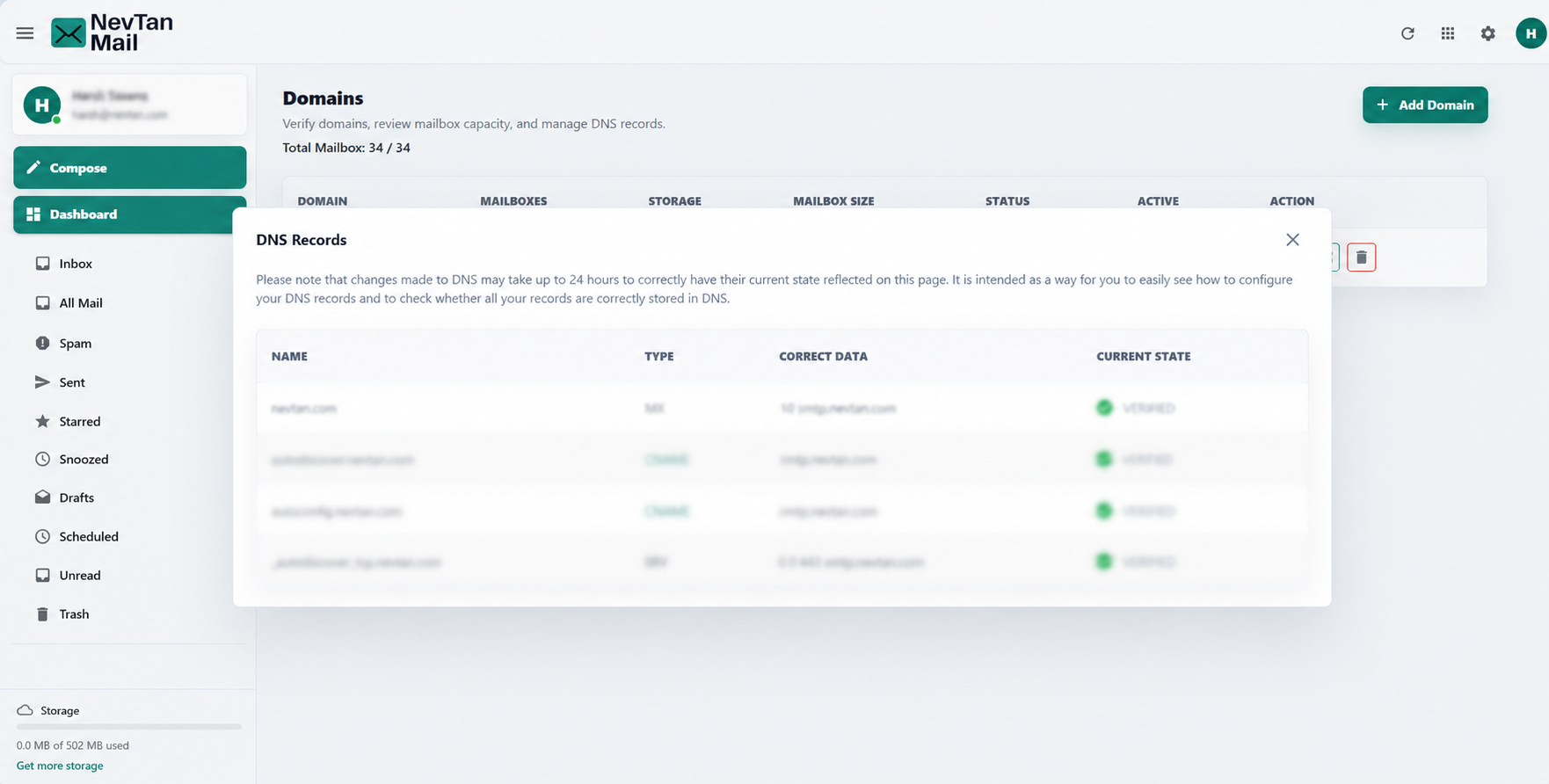
Name is what to call the record, Type is the record type to choose (MX, TXT, or CNAME), Correct Data is the value to paste, and Current State shows whether we can already see it published.
Copy each value exactly
Select the text in Correct Data and copy it. Paste rather than retype — DKIM values in particular are long, and a single altered character makes the record invalid.
Keep the screen open while you work
Add the records at your DNS provider in another tab, then come back to this screen to watch each row turn from pending to correct.
If a value looks cut off
Long values — DKIM especially — may be visually truncated in the table. Select the whole field and copy it rather than transcribing what you can see, and paste it into a plain-text editor first if you want to confirm you have all of it.
Don't reuse values between domains or providers
Record values are tied to the specific domain they were generated for. Copying a DKIM record from another domain, an old provider, or an example in an article will fail verification — and mail will keep being rejected until it's corrected.
MX — receiving mail
An MX (Mail Exchange) record tells the internet which servers accept mail for your domain. Without it, mail sent to your addresses never reaches NevTan Mail.
- MX records carry a priority number — lower numbers are tried first. Enter the priority exactly as shown.
- Remove or disable MX records pointing at a previous mail provider. Leaving them in place can send your mail to the old provider.
- MX affects incoming mail only. It has no effect on whether your outgoing mail is accepted.
SPF — who may send
SPF (Sender Policy Framework) is a TXT record listing the servers allowed to send mail using your domain. When a receiver gets a message claiming to be from you, it reads your SPF record and checks whether the sending server is on the list. If not, the message fails SPF.
An SPF record is a single line that looks broadly like this:
v=spf1 <authorized senders> ~all
v=spf1— marks it as an SPF record.- The middle lists who may send — this is the part NevTan Mail fills in for you.
~allor-all— how to treat everyone else (soft fail or hard fail).
Only one SPF record per domain
A domain must have exactly one SPF record. Publishing two causes a permanent error and SPF fails for every message — a common cause of sudden delivery problems. If you already send mail through another service, do not add a second record: merge the senders into your single existing SPF record.
DKIM — signing your mail
DKIM (DomainKeys Identified Mail) adds a cryptographic signature to every message you send. The matching public key is published in your DNS, letting receivers confirm the message genuinely came from your domain and wasn't altered in transit.
DKIM is published on a selector — a subdomain-style prefix that lets a domain hold several keys at once. The record name therefore looks like a longer hostname rather than a bare domain.
- The value is unique to your domain and is the longest of the records — copy it in full.
- Some DNS providers automatically append your domain to the record name. If so, enter only the prefix, not the whole hostname, or you'll end up with it duplicated.
- Don't add line breaks or spaces when pasting. A broken key fails silently — mail sends, but signatures don't validate.
DMARC — the policy
DMARC ties SPF and DKIM together. It tells receivers what to do when a message claiming to be from your domain fails those checks, and where to send reports about it.
| Policy | Means |
|---|---|
p=none | Take no action, just report. A safe starting point while you confirm everything is signing correctly. |
p=quarantine | Treat failing mail as suspicious — typically filed as spam. |
p=reject | Refuse failing mail outright. The strongest protection against someone spoofing your domain. |
A common approach is to start at p=none, confirm from the reports that your legitimate mail passes, then tighten to quarantine and eventually reject.
Publishing the records
Open your DNS records
Go to Admin → Domain, find your domain, and choose DNS.
Sign in to your DNS provider
This is wherever your domain is managed — for example Cloudflare, GoDaddy, Namecheap, or Route 53. It is often not the same company as your website host.
Add each record
Create a record for each row, matching the Name, Type, and Correct Data exactly. Copy and paste rather than retyping — a single wrong character invalidates the record.
Save and wait
Save at your provider. DNS changes need time to spread across the internet before NevTan Mail can see them.
Check the state
Return to the DNS screen and confirm each row reports as correct.
Watch out for the trailing dot and the @ symbol
Providers differ. Some want @ to mean the domain itself; some want the field left blank. Some add a trailing dot to hostnames automatically. If a record won't verify, this is one of the first things to check.
Verifying them
The DNS screen shows every record alongside its Current State, so you can see at a glance what NevTan Mail can and can't find:
| Column | Meaning |
|---|---|
| Name | The record name to create at your DNS provider. |
| Type | The record type — MX, TXT, or CNAME. |
| Correct Data | The exact value to paste in. |
| Current State | Whether NevTan Mail can currently see the record published correctly. |
The state of each row tells you where you stand:
- Correct (green tick) — the record is published and matches. Nothing more to do.
- Pending (amber) — NevTan Mail can't see the record yet. Either it hasn't propagated, or the value doesn't match.
- Optional — recommended but not required for the domain to work.
Alongside the records, the domain itself shows a status in the domain table: Pending until the required records are in place, then Verified.
Allow time to propagate
DNS changes can take up to 24 hours to be visible everywhere, though they are often much quicker. A row showing as pending shortly after you save it usually just needs more time — re-check before assuming the value is wrong.
Troubleshooting delivery
Mail sends, but Gmail or Outlook rejects it
This is the classic symptom of missing or invalid authentication: outgoing mail is accepted by NevTan Mail, then bounced by the recipient's provider with a message about the domain not being authenticated. Work through this in order:
- Open Admin → Domain → DNS and check whether SPF and DKIM both report as correct. If either is pending, that is almost certainly the cause.
- Confirm you have only one SPF record on the domain.
- Check the DKIM value was pasted in full, with no line breaks, spaces, or truncation.
- Confirm the record names are right — particularly whether your provider appends the domain for you.
- Wait for propagation and check again before making further changes.
Read the bounce message itself where you can. Providers usually name the failing check directly, which tells you which record to look at.
Mail arrives, but lands in spam
- Confirm SPF and DKIM both report correct — passing authentication is the single biggest factor.
- Add DMARC if you haven't. A domain with no DMARC record is treated with more suspicion.
- New domains have no sending reputation. Build up volume gradually rather than sending a large batch on day one.
Mail isn't arriving at all
- Check the MX records report as correct — incoming mail depends on them.
- Make sure no MX records for a previous provider are still published.
- Confirm the mailbox exists and is Active — see the mailbox notes in Create & manage mailboxes.
Still stuck after the records report as correct? Email support@nevtan.com with your domain name and the full text of a bounce message, and we can look at it with you.
Still need a hand?
Our support team usually replies within one business day.
Email us at support@nevtan.com